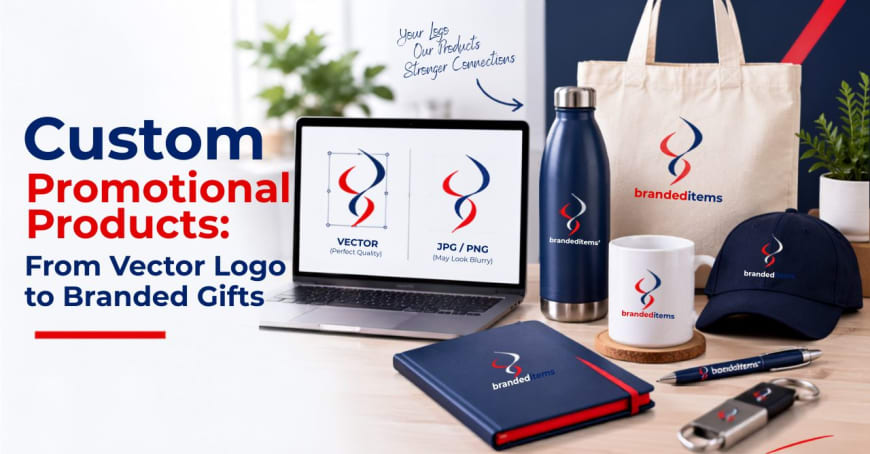
You've picked the perfect promotional product, sorted the colours, and you're ready to place the order. Then comes the question that stops a lot of business owners in their tracks: “Can you send your logo in vector format?”
If your first thought was “isn't a logo just a logo,” you're not the only one. Most people work with their branding as a JPG or PNG day to day, saved straight off the website or pulled from an old email signature, so being told that file suddenly won't do can feel like an odd hurdle right before you're ready to go.
Custom promotional products are branded items created with a business's logo, colours or messaging. They can include everything from pens, drink bottles and tote bags to apparel, event merchandise and corporate gifts. But before you can apply your branding to these products, the artwork must suit the chosen printing or decoration method.
That's where vector artwork comes in. It can be the difference between custom promotional products that look sharp and professional and branding that looks blurry or distorted. Here's what a vector logo actually is, why it matters for promotional products and branded gifts, and how to check whether yours is suitable before it costs you time or a reprint.
What Is a Vector Logo?
A vector logo is built from mathematical points, curves and shapes rather than a grid of coloured dots. That sounds technical, but the practical upshot is simple: a vector logo can be scaled up or down to almost any size and stay crisp.
The same logo file that looks fine on a business card can be blown up onto a three-metre event banner, embroidered onto a polo shirt, or printed on a tiny pen, and it will still come out sharp. No pixelation, no blur, no jagged edges. This matters when your branding needs to appear consistently across different custom promotional products and corporate gifts.
The common vector formats you'll come across are EPS, AI (the native Adobe Illustrator format), SVG and vector PDF. One thing to know: saving a JPG or PNG as a PDF doesn't make it a vector file. The artwork has to have been built as vector from the start, or properly converted.
Vector vs Raster: What's the Actual Difference?
JPGs and PNGs are raster images, made up of thousands of tiny coloured squares called pixels. They're perfectly suited to screens: your website, email signatures, social media posts and presentations all run on raster files without any issue.
The problem shows up at print size. Enlarge a raster logo past its original resolution and those pixels start to show. The edges go soft, text can blur, and what looked crisp on a laptop screen suddenly looks amateurish on an umbrella, tote bag or media wall.
Vector artwork doesn't have that ceiling because it isn't built from pixels in the first place. Scale it up as far as you like, and the lines stay clean, which is exactly what you want across a full range of custom promotional products.
| Vector Logo | Raster Logo |
|---|---|
| Built from mathematical paths | Built from pixels |
| Can be scaled without losing quality | Can become pixelated when enlarged |
| Common formats include EPS, AI and SVG | Common formats include JPG and PNG |
| Suitable for many print and decoration applications | Often better suited to digital use and some print applications |
The key point is that the best file format depends on the product and production method. Your supplier can confirm the exact artwork requirements before production begins.
Why Custom Promotional Products and Corporate Gifts Need Vector Artwork
Different branded items are decorated using different techniques, including:
- ✓Screen printing
- ✓Pad printing
- ✓Embroidery
- ✓Laser engraving
- ✓Digital transfer
- ✓Debossing
- ✓Supacolour and heat transfer
- ✓Sublimation printing
Many of these processes benefit from, or require, clean vector artwork, particularly when a logo needs to be separated into individual colours, converted into precise outlines, or reproduced at different sizes. Exact artwork requirements can vary depending on the product and decoration method.
Working from vector artwork generally means:
- ✓Sharper, cleaner printing
- ✓Logo proportions that stay accurate
- ✓Better separation between colours
- ✓Fine details and small text that stay legible
- ✓Consistent branding across different products and materials
- ✓Easier resizing without any drop in quality
In short, it's the difference between promotional products that look properly made and ones that look rushed. That difference matters when the item is designed to represent your business to a customer or client.
Whether you're ordering everyday branded promotional items for an event or premium corporate gifts for clients, branding quality shapes how people perceive the finished product.
Can You Still Use a JPG or PNG?
Sometimes, yes. It depends on the product, the printing method and the quality of the original file. A high-resolution PNG or JPG can work for some digital printing processes used on certain branded gifts.
It falls apart when the image comes from a website, an email signature, or a social media page. Those files are usually small and low-resolution to begin with, and enlarging them for printing makes the pixelation more obvious.
If proper vector artwork isn't available, you may need to redraw the logo or convert it into a usable vector file. That process is called vectorisation, and we can take care of it for you before your custom promotional products go into production. If you're unsure about your artwork, it's better to have the file checked before placing an order than to discover an issue during production.
How Do You Know If Your Logo Is Vector?
The easiest starting point is to check the file extension. Look for EPS, AI, SVG, or a PDF your designer supplied directly. That said, the file extension alone isn't proof. A JPG can be dropped into an Illustrator file or a PDF without ever being converted to vector, so that the file type can be misleading.
Zoom in and check the edges
A quick test you can do yourself is to zoom in on the logo well beyond its normal size. If the edges stay smooth and sharp, it's likely vector. If you start seeing blur or little coloured squares, it's a raster.
Still not sure? Ask your supplier
If you're still not certain, your promotional products supplier or graphic designer can check the file for you. This is particularly useful when you're preparing artwork for several different branded promotional items, as each product and decoration method may have different requirements.
Where to Find Your Vector Logo
If you can't locate the right file, a few places worth checking include:
- ✓The graphic designer who created your logo
- ✓Your marketing department or advertising agency
- ✓Your website developer
- ✓The printer behind your business cards or signage
- ✓Whoever manages your brand guidelines
- ✓The company handling your current order for branded promotional items
When a logo is designed professionally, the designer should hand over a full logo package covering both print and digital formats. It's worth keeping those original files somewhere safe and shared, so they're easy to find next time you need marketing materials, corporate gifts or branded merchandise. Having the correct artwork ready can also make future orders of custom promotional products quicker and easier.
A Quick Note on Pantone Colours
Vector artwork also helps printers identify and separate the individual colours in your logo. For many custom promotional products, supplying Pantone Matching System (PMS) colour references alongside your vector file gives the printer the best shot at matching your brand colours accurately.
Screen colours and printed colours don't always match exactly, and results can vary depending on the material and printing method used. Pairing vector artwork with your PMS references helps maintain greater consistency across different branded products. This is especially important when you're ordering several types of promotional items at the same time and want your brand to look consistent across every product.
Why It's Worth Getting It Right
Your logo represents your business, and even a high-quality promotional item can look off if the branding is blurry or distorted. Supplying the correct vector artwork upfront can also help avoid production delays and unnecessary artwork revisions. It also lets your supplier prepare a clear digital mock-up for approval faster, whether you're ordering pens, drink bottles, apparel, umbrellas, bags, event signage, or corporate gifts for a client. For businesses looking for promotional items in Melbourne, the same principle applies: quality artwork is key to producing consistent branded promotional items, regardless of the product or decoration method. Getting the artwork right before production can save time, reduce back-and-forth and help ensure the finished products reflect your brand as intended.
Need a Hand With Your Artwork?
Not everyone deals with printing terminology or artwork formats regularly, and that's fine; it's what we're here for. At Brandeditems, we provide complimentary digital mock-ups so you can see exactly how your branding will look before anything goes into production. If you're not sure whether your logo file is print-ready, send it through, and our team will check it at no cost.
Get in touch with Brandeditems today if you need custom promotional products for an upcoming event, branded promotional items to hand out at scale or corporate gifts for clients in Melbourne and beyond. We'll help you get the artwork and the product right the first time.